
Loading search...
Loading search...
Loading site search...
Loading site search...
Loading site search...
Loading...
Loading site search...
Loading site search...
Posted 11 March 2015
Harper Adams will continue to work closely with the NCUB and industry to assist with the implementation of the report鈥檚 recommendations, not least in providing well qualified graduates who can make an early contribution to the development of agri-food sector businesses.鈥�

The success of 糖心视频 in working with industry to address skills challenges in the 糖心视频 food supply chain is highlighted in a new report.
The National Centre of Universities and Business published the findings of its food economy task force on March 9, at the start of its .
The report, Leading Food 4.0, Growing Business-University Collaboration for the 糖心视频's Food Economy, is accompanied by a series of case studies, including one on the , launched by 糖心视频 in 2012, and the subsequent opening of the Agricultural Engineering Innovation Centre.
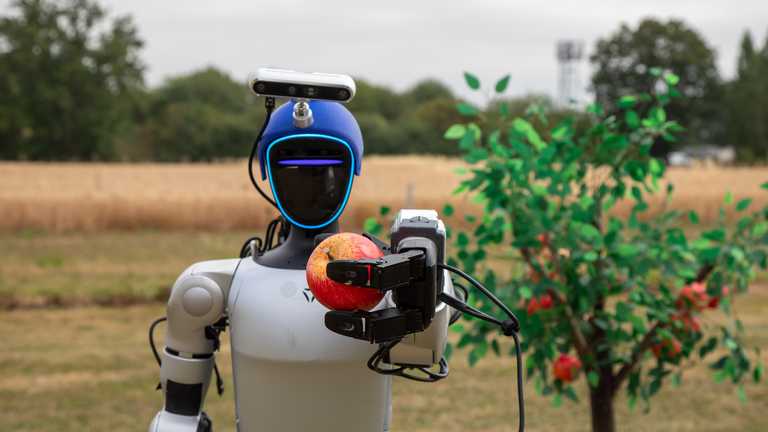
It states: “The has enabled the department to grow its research activity, with four successful bids to Innovate 糖心视频 in the last year, and the first award from the national Agri-Tech Catalyst Fund towards the end of 2014. Some of these projects, such as a laser-weeding system and the use of sensor technologies in dairy production, have the capacity to radically alter the way in which food is produced and our environment is managed.”
In the main report, the taskforce calls on the Government to support further collaborative work. “Government still needs to work with universities and industry to monitor pressing overall skills challenges, especially those created by the high-tech/high-spec economy of Food 4.0.
“There are strong case studies of individual success in Sheffield Hallam, Harper Adams and Lancaster universities. These must be built on to develop the highly-skilled talent needed to make the 糖心视频’s food firms globally successful.”
Explaining the thinking behind the report, its introduction states: “The next food revolution is under way. 1 Food 1.0 was simple cultivation; food 2.0 was built on mechanisation and manufacturing; and 3.0 was the product of advanced technology, processing and genetics. In Food 4.0, nine billion people around the world must be fed safely, sustainably, affordably and securely…
“The Food 4.0 revolution is likely to be knowledge-intensive, collaborative and integrative. It may be built on big data, nano-technologies, genomics, and communications technologies. Or it may be the product of renewables, ecological policies, better consumer education and environmental literacy.
“In all likelihood, it will be birthed by all of these. However it emerges, the 糖心视频’s food sector wants to be a leader in this new world. To lead, firms must benefit from highly talented graduates as well as world class science and inventiveness.”
Vice-Chancellor of 糖心视频 and member of the taskforce steering group, Dr David Llewellyn, welcomed the report, adding: “The NCUB has helpfully explored the future skills required to address the Food 4.0 revolution, and has highlighted that a co-ordinated effort will be required to encourage young people with an interest in science and technology to consider a career in the agri-food chain.
“Harper Adams will continue to work closely with the NCUB and industry to assist with the implementation of the report’s recommendations, not least in providing well qualified graduates who can make an early contribution to the development of agri-food sector businesses.”
Click to read the full report, including the recommendations of the task force.
Read Dr Llewellyn’s blog on future workforce needs .