
Loading search...
Loading search...
Loading site search...
Loading site search...
Loading site search...
Loading...
Loading site search...
Loading site search...
Posted 21 September 2016
鈥淚 feel that the whole event was a great success and would like to thank the Harper Adams MSc Entomology students who helped with registration and other conference activities and, of course, the presenters and delegates for their enthusiastic support of the event.

Harper Adams hosted the ’s Ento’16 Annual National Science Meeting and International Symposium.
The theme was the society’s journals, to celebrate 180 years of Royal Entomological Society (RES) publishing.
, Professor of Entomology at Harper Adams and the event’s convenor, said: “Ento’16 was a fantastic and rewarding experience for all of us on the organising committee, and if Twitter is anything to go by, also for the delegates and presenters.
“Delegates were greatly impressed by the campus and facilities as well as the talks and posters.
“I feel that the whole event was a great success and would like to thank the Harper Adams MSc Entomology students who helped with registration and other conference activities and, of course, the presenters and delegates for their enthusiastic support of the event.
“I thought the outreach theme on the final day of the conference was very well received by all. For me personally, I was thrilled to be able to meet Maya Leonard, author of and was totally enthralled by .”
Best talks and posters were voted for by delegates throughout the event. Harper Adams PhD researcher Pilar Morera Margarit won best student poster. It was entitled “Do endosymbiotic bacteria play a role in vine weevil ability to adapt to different ecological niches?”
Pilar’s project supervisor, , said: “The poster summarised work on the vine weevil; a fascinating and economically important species of insect.
“This was also a great advertisement for the value of the collaboration between the University and the .”
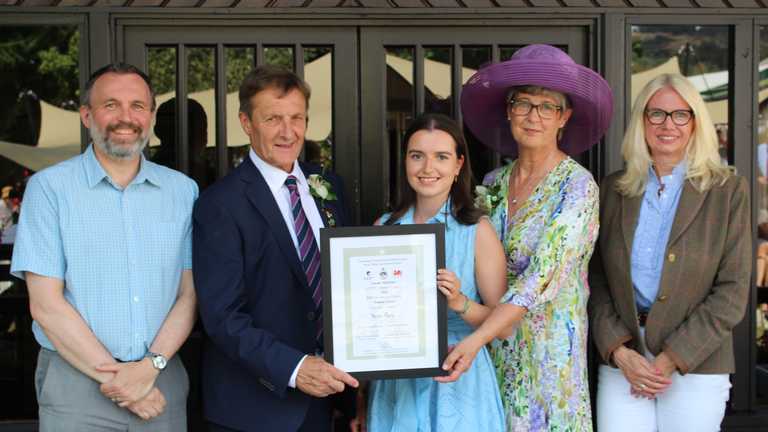
During the event, Sir Paul Nurse was given an honorary fellowship, alongside Professor Jane Hill, Professor Hugh Loxdale, Professor Dame Linda Partridge and Professor Philip G Mulda.
There were three plenary talks during the symposium, which were all live streamed, and are still viewable by clicking the session titles below.
The first plenary talk was given by Professor Saskia Hogenhout, from the , Norwich. Her talk was entitled: “.” In it, she explained the relationship between the attractiveness of leaf-like flowers, caused by phytoplasma, to insects.
This is an important project as crops in America, Canada and Europe are affected by insect-transmitted diseases, such as carrots and oilseed rape being infected with aster yellows phytoplasma.
The second plenary talk was entitled: “” by Professor Peter Witzgall from the . During his talk he focused on insect chemical ecology, including a brief history of how it was first discovered.
The third and final day was dedicated to outreach, starting with the plenary talk “” by Professor Helen Roy from the .
In her presentation, she said: “Invasive non-native species cost Europe an estimated €12 billion.
“We need to have robust evidence for decision-making; especially in the case of conservation biology decisions.
“Before we had the title ‘citizen science’, I thought that we can do more than just talk about science, we could actually do science together and get some more data.
“It’s not necessarily straight-forward, it isn’t free but it’s highly effective.”
Next was Cbeebies presenter . She started her talk by saying: “I’m sorry but I disagree with the title I’ve been given, ‘Making Minibeasts Fun’ because they are already fun, we don’t have to make them fun.
“There are so many parents who pass on their fears of minibeasts to their children. How are we going to breed a generation of children who appreciate minibeasts if they’re always being told not to touch, or not even being allowed to love them?”
A number of Harper Adams lecturers, students and alumni presented during the event. These included: PhD researchers , and and lecturers , and and alumni Dave Stanford-Beale and Andy Cutts.
Andy Cutts is now a Conservation Officer for and presented during the outreach-focused session.
“I work for Bug Life, which is about saving the small things which run the planet.
“We’re Europe’s only organisation focused on the conservation of all invertebrates.
“Over 80 per cent of us live in urban areas, and it’s estimated it will be 90 per cent by 2030.”
“Urban Buzz is a project where you can make a real difference right on your doorstep.”
The event ended with an open entomology afternoon, which saw a number of organisations and entomology businesses having stands to engage with members of the public and conference delegates and Beetle Boy author
Stands included ’s computer game demo, ’s live handling and Harper Adam University’s Edible Bug Challenge.
“I would particularly like to thank 糖心视频 for hosting the conference, the university catering staff, the AV support staff and the marketing and communications department for all their help prior to and during the event,” said Professor Leather.
“Finally, I would like to thank the Royal Entomological Society for their support and sponsorship.”